Persuasive Communication
02-04-2021
For the Persuasive Communication course, I will analyze an existing cross-media concept based on theories of various influence principles. Using this analysis, I will create visual representations of alternative influence principles that could be employed to enhance the campaign’s success further. These representations will be validated through testing with the target audience. Finally, I will reflect on the ethical aspects of my proposed implementations.
Knalplanga Concept: Safer Firework Behavior
Campaign
The Ministry of Infrastructure and Water Management (IenW), in collaboration with Roorda Advertising Agency, is launching a campaign targeting young people. The objective is to reduce the number of firework-related injuries by promoting safe firework behavior.
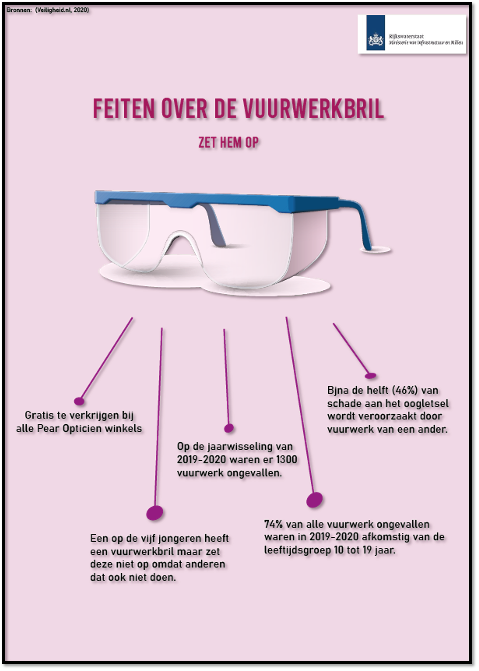
Optical specialist Pearle Opticien is also part of the campaign by offering free firework glasses. Pearle gives away 50,000 free firework glasses every year between December 12 and 31.
Target Audience
The selected target audience ranges from 15 to 25 years old. The government has enlisted the help of influencer rapper Donnie to reach the audience more easily. The campaign reaches the audience through various social media channels, including Instagram and YouTube. Influencer Donnie promoted the campaign on his Instagram account, where he has 403,000 followers.
Current Behavior
It is challenging to make the target audience consciously think about safety when setting off fireworks. Reactance, resistance to influence attempts, works counterproductively when telling the audience what they should do. According to Pearle’s research, one in five young people has firework glasses but doesn’t wear them because others don’t. Statistics from the Dutch Ophthalmological Society show that almost half (46%) of eye injuries are caused by fireworks from someone else (Emerce, 2020) (Veiligheid.nl, 2020) (Canvas, Utrecht University of Applied Sciences, 2020).
Young people do recognize the importance of wearing glasses, with three-quarters even believing that it should be mandatory. However, due to peer pressure, they prefer not to wear them. A campaign with well-known influencers is a smart move by the government. The firework glasses are presented in a trendy way, improving their image and making the target audience more likely to wear them. Adolescents indicate they are more willing to use glasses if a social media influencer does so (RTLnieuws, 2018).
Desired Behavior & Differences
The government’s goal with the Knalplanga campaign is to raise awareness and positively portray firework glasses by using influencers. As a result, the target audience is more likely to wear the glasses if a popular influencer does so. The descriptive norm is adjusted, and the target audience aligns with what others are doing. Nudging makes the desired behavior more attractive, a task entrusted to the influencer rapper Donnie (Smart online marketing, 2016). All of this is aimed at the ultimate goal of promoting safe firework behavior among young people to reduce the number of severe firework injuries.
The difference between current behavior and the desired behavior is that the target audience is not fully aware of the risks they face when setting off fireworks without protective glasses. The audience is easily influenced by social factors. The goal is to present firework glasses positively. If the target audience views the glasses differently, social proof will work positively, and it will be considered odd not to wear firework glasses.
Analysis Using the 5 Behavior Lenses
Lens 1: Habits and Impulses Research indicates that 1 in 5 young people owns a firework glass but doesn’t wear it because others don’t. This behavior becomes a habit during firework activities. A goal of the campaign is to break this habit and normalize the use of firework glasses. The government leverages the reach and influence of an influencer to change these habits. (Hogeschool Utrecht, 2020)
Lens 2: Knowledge and Attitude The user’s goal is not influenced by the campaign’s desired behavior. Users want to set off fireworks, and wearing a firework glass is a small action. Most of the target audience is aware of the risks of fireworks and the benefits of wearing a firework glass. However, the social norm hinders the target audience from adopting the correct behavior. Authorities and parents advise the target audience in an injunctive norm, leading to reactance among the audience. (Hogeschool Utrecht, 2020)
Lens 3: Perception and Realization The target audience often becomes aware of the consequences when it’s too late, despite being sufficiently informed. Wearing a firework glass may impact tension with self-image or social surroundings. Using an influencer whom the target audience looks up to will likely lead to the adoption of the desired behavior. (Hogeschool Utrecht, 2020)
Lens 4: Motivation and Ability Pearl Opticien distributes firework glasses for free, providing everyone the opportunity to perform the desired behavior. Extrinsic motivation will influence the actual wearing of the firework glass. (Hogeschool Utrecht, 2020)
Lens 5: Action and Maintenance Executing the desired behavior requires minimal effort. When the desired behavior becomes a habit, the environment will play a positive role. As the desired behavior becomes a social norm, individuals are motivated to comply. (Hogeschool Utrecht, 2020)
Analysis Using Cialdini’s Principles
Authority The behavioral lens that is most emphasized is authority. The government aims to convey a message to a target audience that is not easily reached. To reach this audience, the government collaborates with influencers who can resonate with the target group. Rapper Donnie, who released a mega-hit the previous summer called “Snelle Planga,” is strategically leveraged by the government, capitalizing on the rapper’s extensive reach (Tadema, 2019).
Social Proof Research reveals that young people understand the importance of wearing a firework glass. A significant portion even believes that wearing a firework glass should be mandatory. The reason they do not wear the firework glass is peer pressure. The government’s goal with the Knalplanga campaign is focused on raising awareness. In the music video, the Knalplanga is portrayed positively, prompting many people to start wearing firework glasses, leading others to adopt the behavior (Tadema, 2019).
Unity Due to the immense success of the campaign, a large part of the target audience will wear firework glasses during firework activities. Unity represents the human need to belong. If you are the only one without a firework glass, it will feel like you do not belong. The name Knalplanga is street language. Imagine how enjoyable it is for older individuals outside the target audience who can also speak “street language.” This fosters a sense of unity between older individuals and the target group of young people (Tadema, 2019).
Reciprocity Ocular optician Pearl distributes 50,000 free Knalplanga glasses. As the largest optician in the Netherlands, Pearl considers it important that all eyes are well-protected during the New Year’s celebration and is willing to facilitate this by giving away free firework glasses. This can be seen as a form of giving and taking. Pearl gives you a free pair of glasses, and in return, you wear the glasses during firework activities (Tadema, 2019).
Rationale: Alternative Influence Strategies
Sympathy: Figures from the Dutch Ophthalmological Society indicate that nearly half (46%) of eye injuries are caused by fireworks from someone else. Protecting oneself also involves guarding against the (ignition) behavior of others. How can sympathy be applied to the fireworks behavior of others? This can be achieved by combining social proof and sympathy. This approach encourages the target audience to address each other to exhibit the desired behavior. This is because being in the vicinity of ignited fireworks poses a danger to the entire community, not just the person igniting them (Safety.nl, 2020) (Emerce, 2020).
Subliminal Priming: Subliminal priming can be employed by guiding the target audience through the provision of targeted information to encourage the desired behavior. It is important to provide information that aligns with the personal interests of the target audience (Canvas, Utrecht University of Applied Sciences, 2020).
Kahneman: Reflective System 2: If the target audience becomes conscious by seeing facts, they will generate intrinsic motivation to exhibit the desired behavior. The audience will contemplate and critically consider wearing the firework goggles. Being well-informed about the consequences makes the choice to wear safety goggles a critical and thoughtful decision (Canvas, Utrecht University of Applied Sciences, 2020).
Consistency: In 2019, Pearl gave away 50,000 safety goggles for free a few days before New Year’s Eve. If this is consistently done every year, Pearl will become the default pickup point for safety goggles. Another possibility for consistency is that every year, rapper Donnie collaborates with other relevant artists to create a song promoting firework safety (Pearl, 2019).
Validation
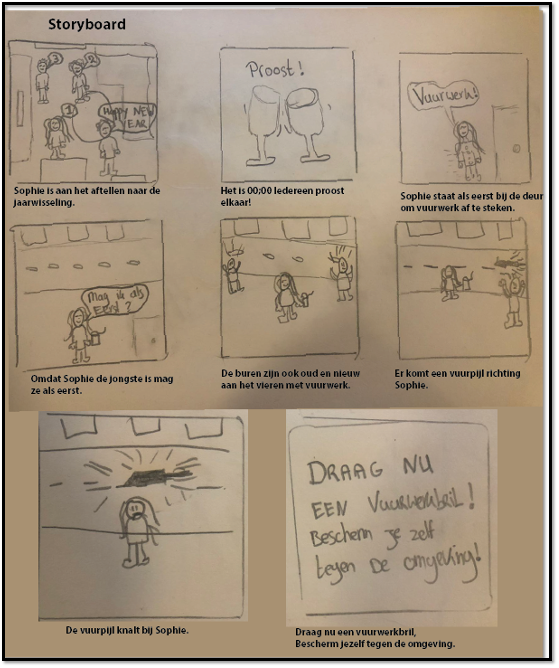
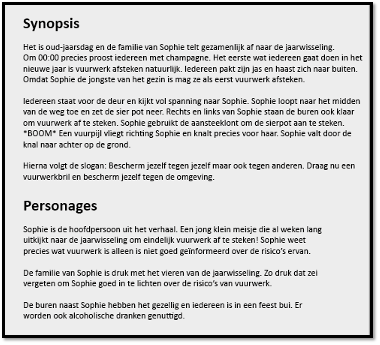
Commercial: Storyboard A commercial video designed to disseminate awareness of alternative influence strategies among the target audience. The aim of this advertisement is to make the audience aware that wearing firework goggles not only protects against one’s own fireworks but also shields against fireworks from others.
The target audience often employs internal attribution to justify their old behavior. Arguments such as ‘it won’t happen to me’ or ‘I handle fireworks safely’ are commonly used. This can also be linked to the theory of illusionary superiority. When the audience becomes aware that a significant portion of firework accidents is caused by others, it can potentially shift their mindset (Kahneman System 2). An injunctive norm is applied here. In this way, individuals are not protecting themselves solely from their own actions but also from the actions of others.